Resuscitation Guide
South African resuscitation flows, source PDFs, metronome, drug prompts, event log and team alerting.
Resus Help
Algorithms
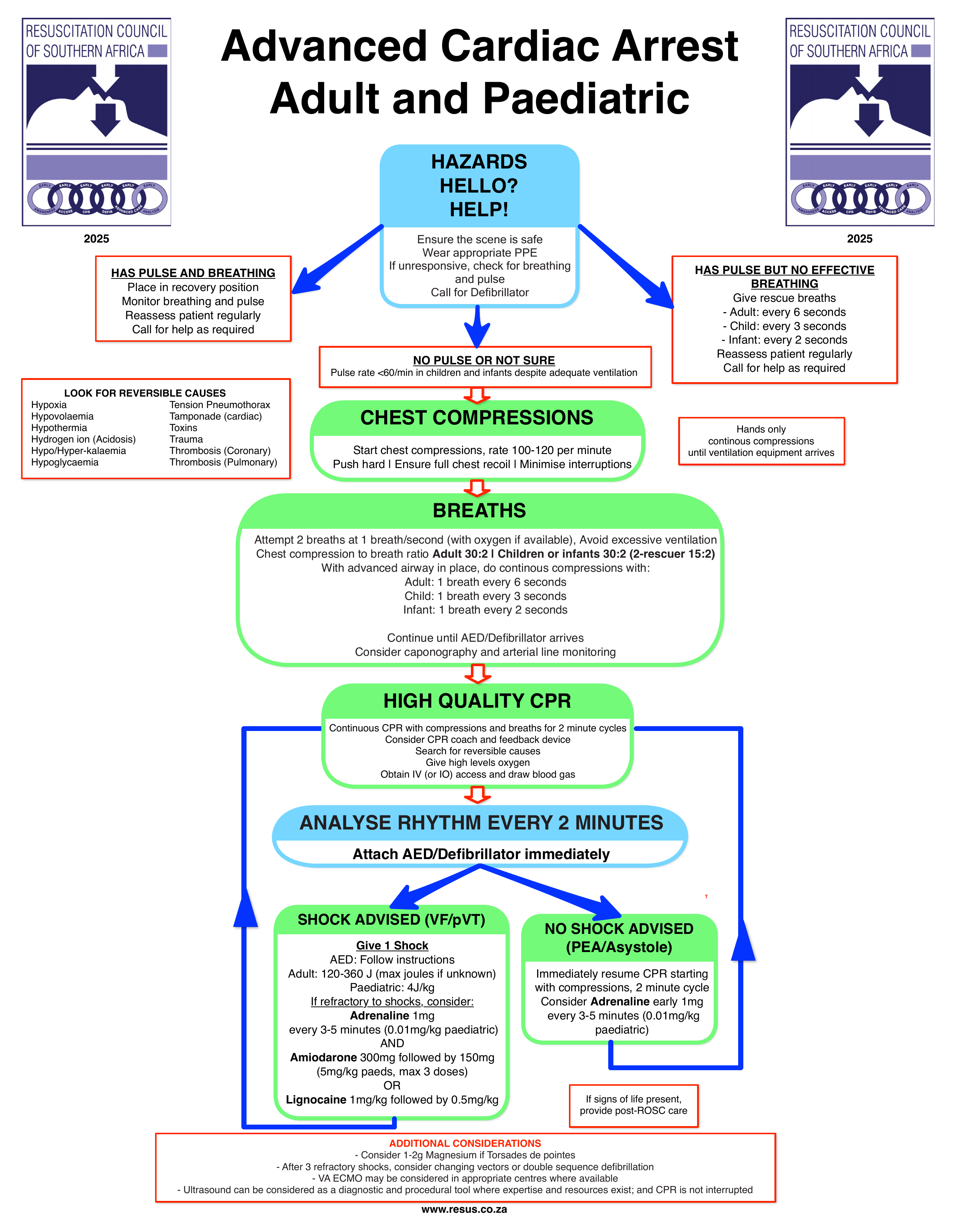
Advanced Cardiac Arrest
Adult and paediatric cardiac arrest pathway with rhythm analysis every 2 minutes.
1
Start with Hazards, Hello, Help
- Confirm scene safety and PPE before entering the resuscitation space.
- Assess response. If unresponsive, check breathing and pulse together.
- Call for help immediately and ask specifically for an AED/defibrillator.
2
If no pulse, or you are not sure, start CPR
- Start chest compressions at 100-120/min.
- Push hard, allow full chest recoil and minimise pauses.
- Use 30:2 for adults, children and infants; use 15:2 for two-rescuer paediatric CPR.
- Hands-only continuous compressions are acceptable until ventilation equipment arrives.
3
Ventilate correctly
- Give 2 breaths at 1 breath/second with oxygen if available.
- Avoid excessive ventilation.
- With an advanced airway: adult 1 breath every 6 seconds, child every 3 seconds, infant every 2 seconds.
4
Analyse rhythm every 2 minutes
- Attach AED/defibrillator immediately when available.
- For VF/pVT: give 1 shock, then immediately resume CPR for a 2-minute cycle.
- For PEA/asystole: immediately resume CPR and give adrenaline early.
5
Drug escalation
- Adrenaline: adult 1 mg every 3-5 min; paediatric 0.01 mg/kg.
- Refractory shockable rhythm: amiodarone 300 mg then 150 mg; paediatric 5 mg/kg, max 3 doses.
- Alternative: lignocaine 1 mg/kg then 0.5 mg/kg.
- Consider 1-2 g magnesium for torsades de pointes.
6
Actively search reversible causes
- Hypoxia, hypovolaemia, hypothermia, acidosis, hypo-/hyperkalaemia and hypoglycaemia.
- Tension pneumothorax, tamponade, toxins, trauma, coronary thrombosis and pulmonary thrombosis.
- Use ultrasound only if expertise is available and CPR is not interrupted.
7
If signs of life return
- Provide post-ROSC care.
- Continue oxygenation, haemodynamic support and definitive cause management.
- Document rhythms, shocks, drugs, timings and response.
Source Algorithm
Original one-page algorithm shown in-page for quick visual reference.